Clinic management systems across Southeast Asia are moving to the cloud — and fast. In 2026, the shift is no longer a question of "if" but "how soon." From Malaysia's LHDN e-invoicing mandate to Singapore's Smart Nation healthcare push, government policy and patient expectations are forcing clinics to abandon paper records and legacy on-premise software. Cloud-based platforms now offer the reliability, security, and accessibility that modern healthcare demands.
What Is the State of Healthcare IT in Southeast Asia?
Healthcare IT in Southeast Asia remains heavily fragmented. Large private hospital chains run enterprise systems, but the vast majority of clinics — GP practices, dental offices, aesthetic centers, physiotherapy studios — still rely on a patchwork of paper records, Excel spreadsheets, and decade-old desktop software.
This fragmentation creates real problems. Patient records are trapped on a single computer. Backup failures mean permanent data loss. Clinic owners cannot access reports or dashboards unless they are physically in the office. Staff waste hours on manual tasks that modern software handles automatically.
The COVID-19 pandemic exposed these gaps. Clinics that relied on on-premise systems struggled to operate during lockdowns. Those with cloud access adapted quickly — managing appointments, teleconsultations, and patient communications remotely. That experience accelerated a shift that was already underway.
What Is Driving Cloud Adoption in 2026?
Four forces are converging to push clinics toward cloud-based systems across the region.
Government Digitization Mandates
Governments across SEA are actively pushing digital adoption in healthcare. Malaysia's LHDN e-invoicing requirement means clinics must generate compliant electronic invoices — something paper-based operations simply cannot do. Singapore's Healthier SG initiative encourages digital patient records and data interoperability. These mandates make digital clinic management a compliance requirement, not just a convenience.
Rising Patient Expectations
Patients in Southeast Asia are mobile-first. They book flights, order food, and manage banking on their phones. They expect the same convenience from their healthcare provider. Online booking, digital invoices, appointment reminders via WhatsApp, and a patient app are no longer premium features. They are baseline expectations. Clinics that cannot offer them lose patients to competitors that can.
Post-COVID Operational Resilience
The pandemic taught clinic owners a painful lesson: if your system only works from the office, your business stops when you cannot be there. Cloud systems provide access from anywhere — home, a second branch, or while traveling. This resilience now ranks as a top priority for practice owners evaluating new software.
Mobile-First Populations
Southeast Asia has some of the highest mobile internet penetration rates globally. In markets like the Philippines, Thailand, and Vietnam, many users access the internet exclusively through smartphones. Cloud-based clinic software with responsive design and dedicated mobile apps aligns perfectly with how both clinic staff and patients already interact with technology.
Country-by-Country Snapshot
Each market in Southeast Asia has its own dynamics pushing cloud adoption. Here is what is happening on the ground.
Malaysia
Malaysia is MedicalMet's home market and one of the most active for cloud clinic adoption. The LHDN e-invoicing mandate is the biggest catalyst — clinics must issue tax-compliant electronic invoices through the MyInvois portal. Legacy desktop software cannot meet this requirement without expensive custom add-ons. Cloud platforms with native e-invoicing support offer a seamless compliance path. Malaysian clinics also benefit from AutoCount and Xero accounting integrations that eliminate manual double-entry.
Singapore
Singapore's Smart Nation initiative has pushed healthcare digitization aggressively. The Healthier SG program encourages primary care clinics to adopt digital records and participate in nationwide health data sharing. Singaporean patients expect polished digital experiences — online booking, digital receipts, and app-based health records. The market demands premium UX, which favors modern cloud platforms over clunky legacy systems.
Philippines
The Philippines has a rapidly growing private clinic sector driven by a large, young, and mobile-savvy population. Many clinics still operate on paper, which means the addressable market for cloud solutions is enormous. Filipino healthcare professionals are increasingly tech-forward, and the lower cost of cloud subscriptions compared to on-premise installations makes the switch financially attractive.
Thailand
Thailand's medical tourism industry is a powerful driver of technology adoption. International patients expect digital check-in, multilingual records, and seamless follow-up communications. Clinics competing for medical tourists need modern systems that deliver a world-class patient experience. Cloud platforms with multi-channel communication and online booking give Thai clinics a competitive advantage in this lucrative market.
Vietnam
Vietnam's digital infrastructure has expanded dramatically in recent years. High-speed internet coverage now reaches most urban centers, and the government actively promotes digital transformation across industries. Private clinics in Ho Chi Minh City and Hanoi are adopting cloud tools faster than anywhere else in Indochina. The absence of entrenched legacy systems in many practices actually makes adoption easier — there is less to unlearn and migrate.
Brunei
Brunei's compact healthcare market means word-of-mouth drives adoption quickly. Several clinics across Brunei already use MedicalMet, and the small market size means cloud vendors can provide hands-on onboarding and support. Brunei's high GDP per capita also means clinics invest willingly in modern tools that improve patient experience.
“We switched from a desktop system we had used for eight years. Within two weeks on the cloud, our staff could not believe how much time they were wasting before. The old system felt like using a fax machine after you have tried email.”
— GP Clinic Owner, Penang, Malaysia
Why Does Cloud Beat On-Premise for SEA Clinics?
The on-premise vs. cloud debate is settled for most Southeast Asian clinics. Here is why cloud wins decisively in this region.
- Multi-location access — manage branches from anywhere without VPN tunnels or remote desktop tools
- Disaster recovery — data is backed up automatically in the cloud, not on a single hard drive vulnerable to theft, fire, or hardware failure
- No IT staff needed — cloud platforms handle server maintenance, security patches, and updates automatically
- Automatic updates — new features and fixes deploy every two to four weeks with zero downtime and zero clinic action
- Lower upfront cost — no server hardware, no installation fees, no annual license renewals
- Scalability — add new branches, users, or modules instantly without hardware upgrades
On-premise systems require a physical server at your clinic. That server needs electricity, cooling, regular maintenance, and someone who knows how to fix it when it fails. For a two-doctor clinic in Manila or a solo dental practice in Chiang Mai, that overhead makes no sense when a cloud subscription costs a fraction of the price and works everywhere.
What Should SEA Clinics Look for in a Cloud CMS?
Not all cloud clinic management systems are built for Southeast Asia. Many platforms are designed for Western markets and lack features critical to this region. Here is what to prioritize.
- Insurance panel billing with local panel pricing support for Malaysian and Singaporean insurers
- WhatsApp Business API integration for appointment reminders and patient communication
- Multi-currency support for clinics serving patients across different SEA countries
- LHDN e-invoicing compliance for Malaysian clinics via the MyInvois portal
- Dedicated patient mobile app — not a mobile website, but a real iOS and Android app
- AI-powered treatment notes with voice recognition that handles Southeast Asian accents
- Medication dispensary with local drug databases and stock control
- No lock-in contracts — month-to-month pricing with full data portability
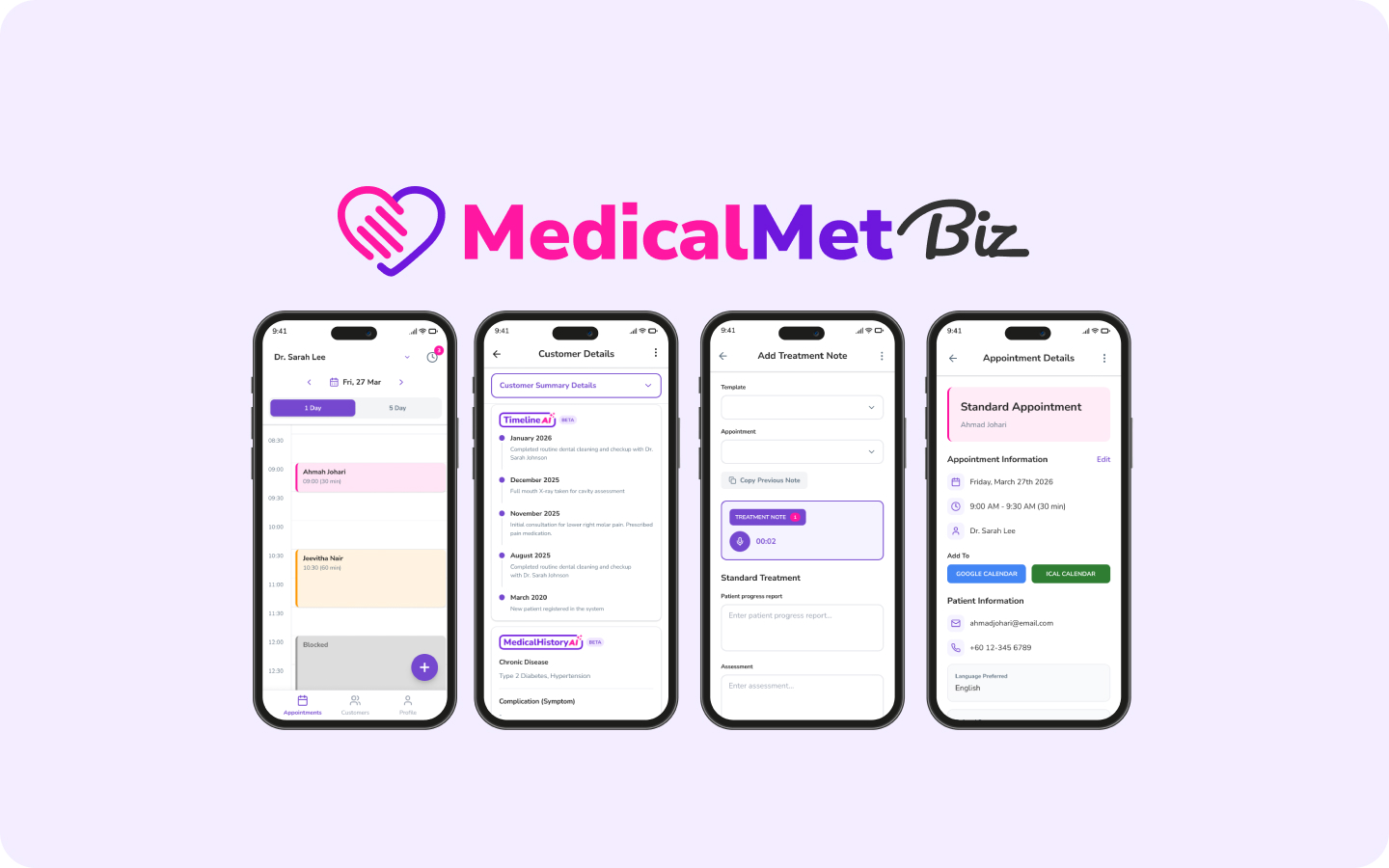
MedicalMet checks every item on this list. The platform was built in Malaysia, designed for Southeast Asian healthcare, and is already trusted by healthcare professionals across six countries. Features like insurance panel pricing, WhatsApp reminders, and medication dispensary are not afterthoughts — they are core modules built from day one.
The Real-World Impact of Going Cloud
Clinics that switch to cloud-based systems report measurable improvements within the first month. Front desk teams reclaim hours previously spent on manual appointment confirmations. Doctors save time with AI-powered treatment notes that auto-fill during consultations. Clinic owners access dashboards and revenue reports from their phone instead of driving to the office.
MedicalMet users have collectively processed over 10,000 voice treatment notes and saved an estimated 5,000 hours of documentation time. Clinics using WhatsApp automation report up to a 90 percent decrease in no-shows. These are not theoretical benefits — they are outcomes measured across thousands of healthcare professionals in the region.
Start Small, Scale Fast
You do not need to migrate everything at once. Many clinics start with scheduling and billing on the cloud, then gradually activate AI treatment notes, WhatsApp automation, and the patient app as the team gains confidence.
The Road Ahead for SEA Healthcare
Southeast Asia's healthcare sector is at a tipping point. Government mandates, patient expectations, and post-pandemic resilience are all pushing in the same direction. Clinics that adopt cloud-based management systems now will operate more efficiently, attract more patients, and scale faster than those clinging to legacy tools.
The clinics that will thrive in 2026 and beyond are not the ones with the biggest budgets. They are the ones willing to adopt the right technology and build their practice around it. Cloud-native, AI-powered, mobile-first — that is the standard. View MedicalMet's plans to see how accessible the switch can be.
“The best time to digitize was five years ago. The second best time is now. Every month on paper is revenue and efficiency left on the table.”
— Cedric Lau, Business Development Manager, MedicalMet

Cedric Lau
Business Development Manager, MedicalMet