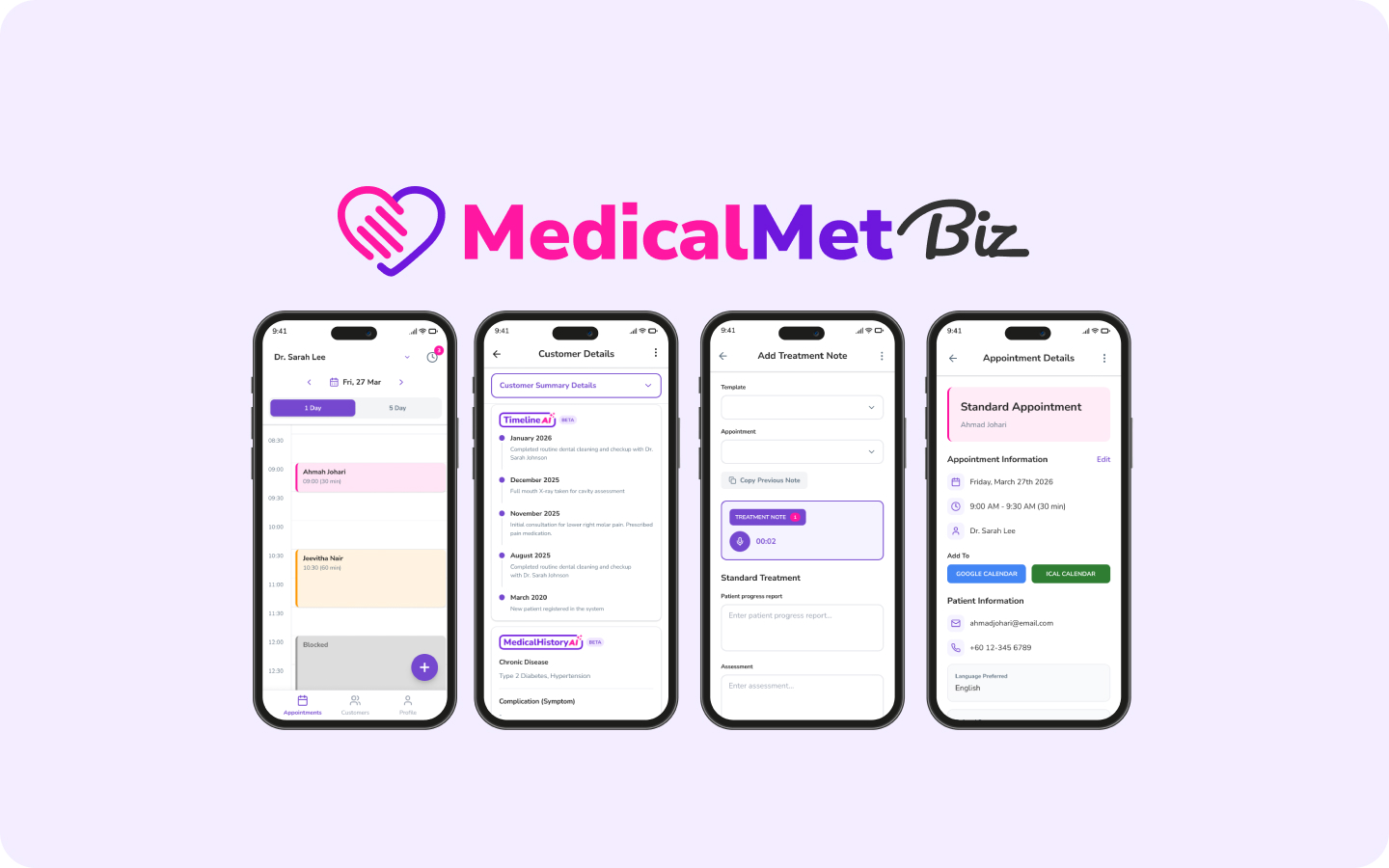
AI treatment notes use voice recognition and natural language processing to convert a practitioner's spoken words into structured clinical documentation — automatically. Instead of typing for 5 to 10 minutes after each patient, the doctor speaks during or after the consultation, and the AI generates a formatted treatment note in seconds. MedicalMet's AI Treatment Notes feature is live in production used by thousands of practitioners in Malaysia and Southeast Asia, processing voice consultations into structured notes that are saved directly to the patient's electronic medical record.
What Are AI Treatment Notes?
AI treatment notes are clinical documentation generated by artificial intelligence from a practitioner's spoken input. The AI listens to the doctor's verbal summary of the consultation — symptoms, examination findings, diagnosis, treatment plan, and prescriptions — then produces a structured, typed note that follows clinical documentation standards.
This is different from simple speech-to-text transcription. A transcription tool gives you a raw transcript of everything spoken. AI treatment notes go further: they extract the clinically relevant information, organise it into sections (subjective, objective, assessment, plan), remove filler words, and output a clean note ready for the medical record.
How Do AI Treatment Notes Work? A Step-by-Step Walkthrough
Here is exactly what happens when a practitioner uses MedicalMet's AI Treatment Notes during a patient visit:
- Practitioner opens the patient's record — The doctor navigates to the patient profile in MedicalMet and starts a new consultation. Previous treatment history and the AI Clinical Timeline are visible for context.
- Voice input begins — The practitioner taps the microphone button and speaks naturally. They can describe the consultation in their own words: "Patient presents with lower back pain radiating to the left leg, onset two weeks ago after lifting. No numbness. Diagnosed lumbar strain. Prescribed ibuprofen 400mg three times daily for five days. Follow-up in one week."
- AI processes the audio — MedicalMet's AI engine converts the speech to text, then applies clinical NLP to extract structured data: chief complaint, history of present illness, examination findings, diagnosis, treatment plan, and medications.
- Structured note is generated — Within seconds, the AI produces a formatted treatment note with labelled sections. The note follows clinical documentation conventions and uses proper medical terminology where the practitioner used informal language.
- Review and save — The practitioner reviews the generated note on screen, makes any edits, and saves it to the patient's EMR. The entire process takes under two minutes.
The key point is that the practitioner's workflow barely changes. They describe the consultation as they normally would to a colleague — the AI handles the documentation formatting.
Manual vs AI: How Much Time Does It Actually Save?
The time savings are significant and measurable. Here is what documentation looks like before and after AI:
- Manual typing — 5 to 10 minutes per patient. The doctor finishes the consultation, then sits down to type notes from memory. Details get missed. Notes are often completed hours later or at the end of the day.
- AI voice-to-text — 1 to 2 minutes per patient. The doctor speaks during or immediately after the consultation. The AI generates the note in seconds. The doctor reviews and saves.
For a clinic seeing 40 patients per day, that is the difference between 3 to 7 hours of daily documentation time versus 40 to 80 minutes. Over a month, AI treatment notes can recover 60 to 100+ hours of practitioner time (MedicalMet internal data, 2025). That time goes back into seeing more patients, taking breaks, or leaving the clinic on time.
“Documentation should take seconds, not steal hours from your day. Every minute spent typing after a consultation is a minute that could have been spent with the next patient.”
— Eddy Goh, CTO, MedicalMet
Which Clinic Types Benefit Most from AI Treatment Notes?
AI treatment notes benefit any clinic where practitioners document patient encounters. But certain verticals see outsized impact:
- GP clinics — High patient volumes (30–50+ per day) make manual documentation a major bottleneck. AI notes keep the queue moving.
- Specialist clinics — Detailed consultation notes for complex cases take the longest to type manually. AI captures the nuance in seconds.
- Aesthetic clinics — Treatment protocols, product usage, and before/after observations need to be documented for each session.
- Dental clinics — Procedure documentation, tooth-specific findings, and treatment plans are structured and repetitive — ideal for AI formatting.
- Physiotherapy centres — Physio practitioners use both hands during manual therapy. They cannot type during treatment. Voice is their only realistic documentation option.
- Chiropractic centres — Chiropractors performing spinal adjustments need both hands throughout the session. AI voice notes capture adjustment details in real time without interrupting the treatment flow.
Hands-Free Documentation for Physiotherapists and Chiropractors
Physiotherapists and chiropractors face a unique challenge that desk-based doctors do not: they use both hands during treatment. A physio performing manual therapy on a patient's shoulder cannot stop to type notes. A chiropractor performing a spinal adjustment cannot pause to write down the technique, segment, and force used.
For these practitioners, AI voice-to-text is not a convenience — it is the only practical way to document during the session itself. Without it, they must rely on memory and type everything after the patient leaves, which leads to incomplete notes and wasted time between appointments.
MedicalMet's AI Treatment Notes work with a simple tap-and-speak interface. The practitioner speaks while treating the patient — "Performing grade IV mobilisation on L4-L5, patient reports decreased pain at end range" — and the AI captures, structures, and formats the note. No keyboard required.
Voice Notes Work Best When You Speak Naturally
You do not need to use formal medical terminology or follow a rigid script. Speak as you would to a colleague describing the consultation. The AI handles formatting and structure.
Are AI Treatment Notes Safe for Patient Data?
Data security is the most common concern clinic owners raise about AI documentation. Here is how MedicalMet handles it:
- All data stays within MedicalMet — Voice recordings and generated notes are processed within MedicalMet's secure infrastructure. Patient data is not sent to third-party consumer AI services.
- Secure cloud storage — All treatment notes, patient records, and voice data are stored securely in MedicalMet's cloud infrastructure with daily backups.
- Role-based access controls — Only authorised practitioners can view and edit treatment notes. Every access is logged in the audit trail.
- Cloud backup — Daily automated backups ensure no data is lost. Notes are recoverable even if a device is lost or damaged.
- Audit trail — Every note creation, edit, and access is logged with timestamps, user identity, and action type.
Patient data never leaves the secure MedicalMet environment. The AI processes voice input within the same infrastructure that stores your EMR, invoices, and appointment data.
AI Treatment Notes FAQ
How accurate are AI treatment notes?
MedicalMet's AI generates clinically structured notes from voice input with high accuracy. However, every note should be reviewed by the practitioner before saving. The AI is a documentation assistant, not a replacement for clinical judgement. Practitioners can edit any section of the generated note before it is committed to the patient record.
What languages are supported for voice input?
MedicalMet's AI Treatment Notes support English and Bahasa Malaysia voice input. The system handles mixed-language input common in Malaysian clinical practice, where practitioners switch between English medical terminology and Malay conversational context.
Do I need special hardware or a microphone?
No. MedicalMet's AI Treatment Notes work with the built-in microphone on any laptop, tablet, or smartphone. No specialised dictation hardware is required. For noisy clinic environments, a basic headset microphone can improve input quality.
Can AI treatment notes be customised for my clinic type?
Yes. MedicalMet offers customisable treatment note templates that adapt to different clinic types. GP clinics, dental practices, aesthetic centres, physiotherapy centres, and chiropractic practices each have templates tailored to their documentation needs. The AI generates notes that follow the selected template structure.
Eddy Goh
CTO, MedicalMet