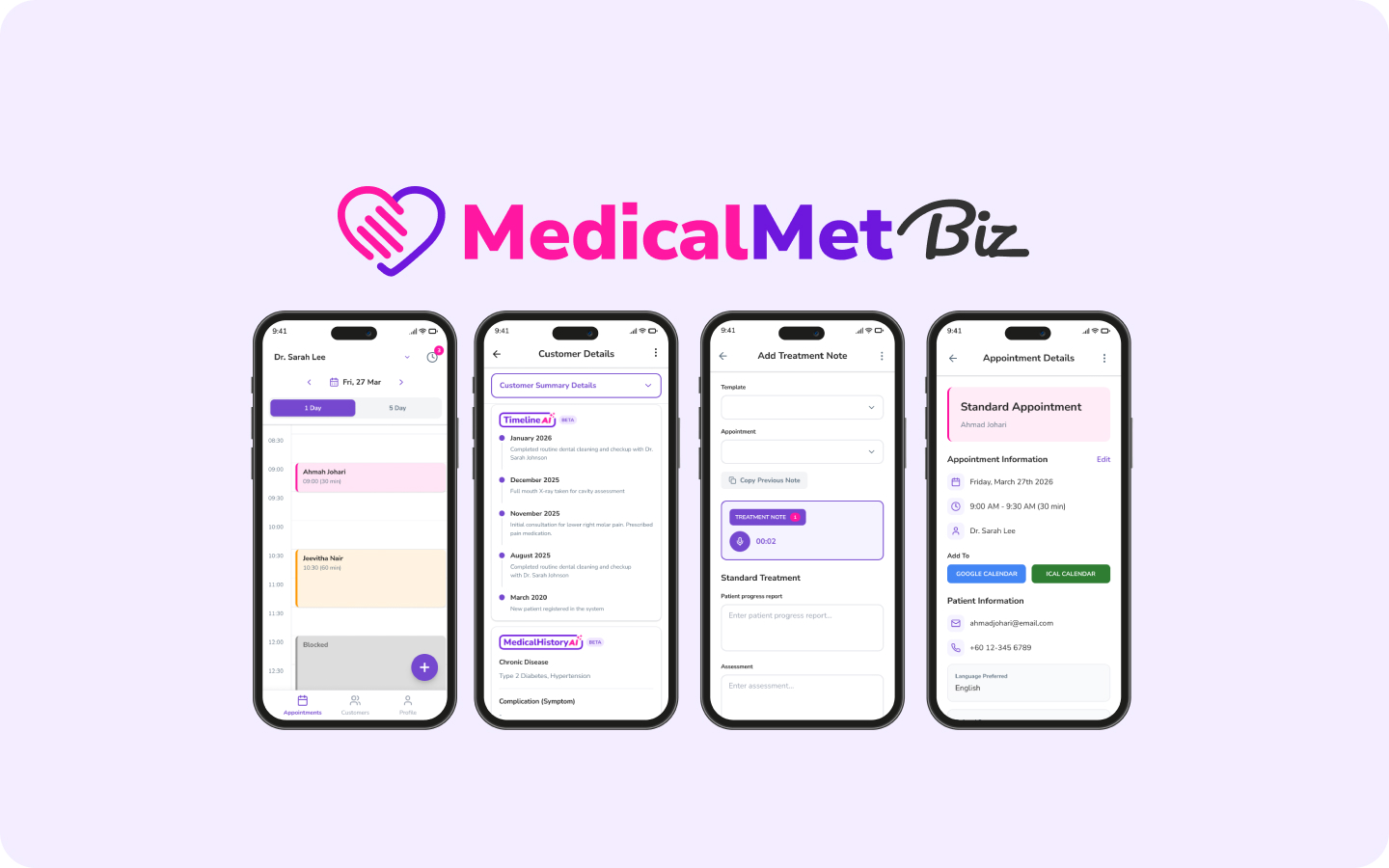
AI medical documentation cuts treatment note writing time from 3–5 minutes per patient to under 30 seconds. For a doctor seeing 40 patients per day, that translates to 10 hours saved every week — time that goes back to patient care, continuing education, or simply going home on time. Voice-to-note AI is now the fastest-growing category of healthcare AI tools, and clinics across Southeast Asia are adopting it faster than any other AI feature.
Why Is Documentation the Biggest Problem for Doctors?
Clinical documentation is the leading cause of doctor burnout worldwide. Studies consistently show that for every hour of direct patient care, doctors spend one to two additional hours on documentation. In high-volume clinics across Malaysia and Singapore, doctors routinely stay 1–2 hours after the last patient leaves just to finish their notes.
The problem is not laziness — it is volume. A GP clinic seeing 40 patients per day generates 40 treatment notes. Each note requires documenting symptoms, examination findings, diagnoses, treatment plans, prescriptions, and follow-up instructions. At 3–5 minutes per note, that is 2–3 hours of pure typing every day.
How Does Voice-to-Note AI Actually Work?
MedicalMet's AI Treatment Notes use a proprietary voice recognition model purpose-built for clinical conversations. The process is simple:
- The doctor wears earbuds or uses a wireless microphone during the consultation.
- The AI listens to the doctor-patient conversation in real time.
- It transcribes the spoken words and identifies clinical entities — symptoms, diagnoses, medications, dosages, and follow-up plans.
- These entities are mapped to the correct fields in the clinic's custom treatment note template.
- By the end of the consultation, the note is drafted and ready for the doctor to review in 15–30 seconds.
The key difference from generic transcription tools: MedicalMet's AI does not just transcribe — it structures. A rambling 10-minute conversation becomes a clean, formatted treatment note with each field populated correctly. The doctor does not need to copy-paste or reorganise anything.
What Makes Clinical AI Different from Generic Transcription?
Generic voice-to-text tools like Google Speech or Whisper produce a wall of text. Useful for dictation, but not for clinical documentation. Clinical AI understands medical terminology, conversation context, and note structure:
- Medical vocabulary — drug names, dosages, anatomical terms, and procedure codes are recognised accurately.
- Contextual understanding — the AI knows that "take two twice daily" is a prescription instruction, not a note about counting.
- Template mapping — output goes directly into your clinic's custom form fields, not a blank document.
- Multi-speaker awareness — the AI can distinguish between doctor and patient speech in the conversation.
What Do the Numbers Look Like in Practice?
MedicalMet has processed over 10,000 voice treatment notes across clinics in Malaysia, Singapore, and Brunei, saving an estimated 5,000 practitioner hours (MedicalMet data, 2025). Here is how the time savings break down for a typical clinic:
- Time per note (manual): 3–5 minutes of typing after each consultation.
- Time per note (AI): 15–30 seconds for review and approval.
- Daily savings (40 patients): 2 hours reclaimed.
- Weekly savings: 10 hours per practitioner.
- Monthly savings: 40+ hours — equivalent to a full work week returned every month.
Which Medical Specialties Benefit Most?
Every specialty that documents consultations benefits, but some see outsized gains:
- GP clinics — highest volume, fastest ROI. 40+ patients/day means massive cumulative time savings.
- Dental practices — detailed treatment plans and procedure notes are structured automatically.
- Aesthetic centres — consultation notes, before/after documentation, and consent records.
- Physiotherapy and chiropractic — session-by-session progress notes that track treatment evolution over time.
- TCM clinics — complex herbal prescriptions and diagnostic notes that follow traditional frameworks.
- Specialist clinics — longer consultations produce more detailed notes, so the time savings per patient are even larger.
MedicalMet supports 13 healthcare verticals with industry-specific note templates for each.
“I used to dread the paperwork after clinic hours. Now my notes are done before the patient even stands up. It is the single best upgrade I have made to my practice.”
— Specialist Doctor, Mont Kiara (MedicalMet customer)
How Do You Get Started with AI Documentation?
The learning curve is minimal. Most doctors are comfortable within 2–3 consultations. Setup involves configuring your clinic's custom note template in MedicalMet (which the onboarding team helps with) and pairing a microphone or earbuds. From there, the doctor simply speaks as they normally would during a consultation.
MedicalMet includes AI Treatment Notes in all plans, starting from $12/month. Every plan comes with a 30-day free trial — enough time to process hundreds of notes and see the time savings firsthand.
Eddy Goh
CTO, MedicalMet